

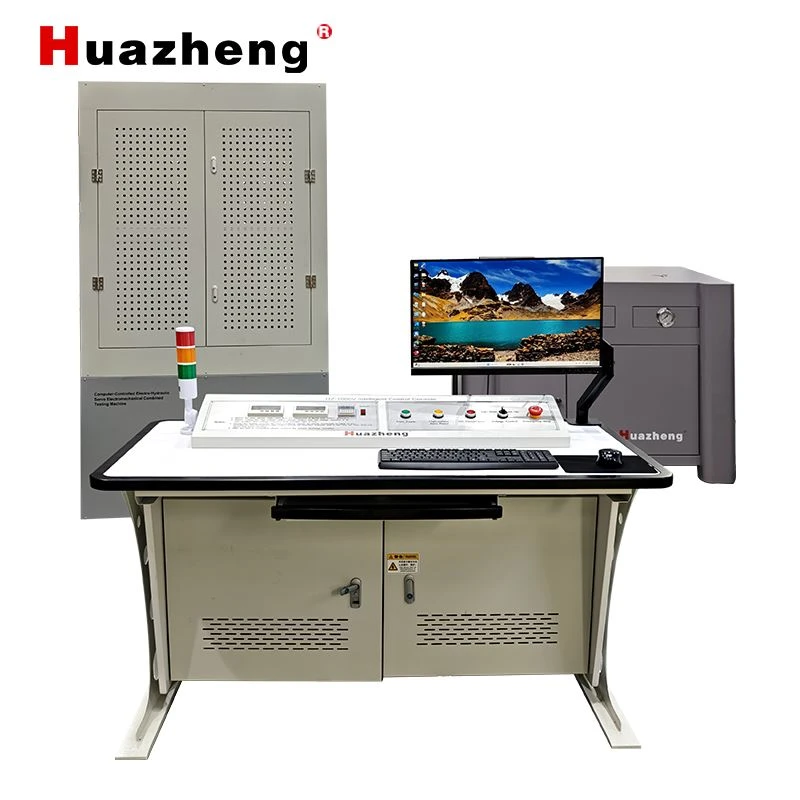
HZ-1000V 1000kN Insulator Electromechanical Test Machine
Huazheng Electric Manufacturing (Baoding) Co., Ltd. is one of the leading manufacturers and suppliers of HZ-1000V 1000kN Insulator Electromechanical Test Machine in China. Please feel free to buy high quality equipment for sale here from our factory. Good service and reasonable price are available.
1000kN Insulator Electromechanical Testing Machine
Product Description
The HZ-1000V Insulator Electromechanical Destruction Testing Device is a multi-system integrated test bench engineered in strict accordance with IEC 60383-1, IEC 60797, and GB/T 1001.1-2021 standards. Designed for high-voltage transmission utilities, insulator manufacturing plants, and third-party electrical metrology laboratories, it evaluates the combined electrical dielectric integrity and mechanical load-bearing capacity of overhead line disc suspension insulators.
Production basis
GB/T1001.1-2021 Insulators for Overhead Lines with Nominal Voltage Above 1000V - Part 1: Definitions, Test Methods and Judgment Criteria for Porcelain or Glass Insulators for AC Systems
GB/T 7253-2019 "Characteristics of porcelain or glass insulators for AC systems with nominal voltage higher than 1000V - Insulators for overhead lines - Characteristics of disc suspension insulators"
GB/T 21421.2-2014 Composite Insulator String Elements for Overhead Lines with Nominal Voltage Higher than 1000V - Part 2: Dimensions and Characteristics
Diagnostic Purpose & Critical Problems Solved
Suspension insulators (toughened glass, high-strength porcelain, and composite insulator units) are critical structural components of overhead transmission lines operating from 110 kV to 1000 kV UHV. In service, these units must simultaneously endure:
Enormous Static & Dynamic Tensile Stresses: Sustaining conductor deadweight, extreme wind buffeting, galloping vibrations, and sudden ice-shedding impact shocks.
High Electrical Voltage Stress: Withstanding continuous operating phase-to-ground power frequency voltages, lightning surges, and switching overvoltages.
If an insulator possesses latent micro-fractures, improper cement curing, metallurgical defects in the cap/pin, or electrical puncture weaknesses, sudden mechanical separation drops transmission conductors, triggering catastrophic grid blackouts.
Target Testing Applications
High-Voltage Transmission Utilities & Power Grid Inspection Centers: Acceptance testing, annual batch quality audits, and residual strength assessments of harvested service-aged insulators.
Porcelain, Glass & Composite Insulator Manufacturing Facilities: Factory Acceptance Testing (FAT), routine mechanical tensile proof testing, and destructive type testing.
Power Research Institutes & Electrical Metrology Laboratories: Verification of newly developed ultra-high voltage (UHV) suspension insulator designs.
Heavy Industrial Electrical Substations & Railway Traction Utilities: Verification of catenary tension insulators and substation busbar suspension strings.
Technical Specifications
| Parameter | Specification Value | Testing & Engineering Notes |
|---|---|---|
| Model | HZ-1000V | Integrated electromechanical destruction test system |
| Mechanical Tensile Output | 0 ~ 1000 kN (approx. 100 Metric Tons) | Closed-loop electro-hydraulic servo control |
| Mechanical Force Accuracy | ±0.5% of reading | Precision high-capacity load cell |
| High Voltage Output | 0 ~ 100 kV (Power Frequency AC) | Synchronized voltage application during tensile pull |
| Voltage Measurement Accuracy | ±1% of full scale | Precision capacitive/resistive divider feedback |
| Piston Travel (Stroke) | 0 ~ 400 mm | Accommodates various insulator unit string lengths |
| Displacement Accuracy | ±1% | High-resolution linear optical encoder measurement |
| Piston No-Load Speed | 0 ~ 150 mm/min | Smooth hydraulic ram positioning |
| Jog Positioning Speeds | 0.2 mm/s, 0.6 mm/s, 1.3 mm/s | Selectable via ergonomic handheld jog pendant |
| Insulator Rating Scope | 4 t ~ 55 t (40 kN ~ 550 kN) | Covers distribution to UHV transmission disc insulators |
| Standard Fixture Molds | 4T, 7T, 12T, 16T Ball-and-Socket | Precision-machined high-strength alloy coupling adapters |
| Operating Power Supply | AC 380 V ± 10%, 63 A (3-Phase, 50/60 Hz) | Industrial high-voltage laboratory power grid |
| Grounding Requirement | Dedicated station earth, resistance < 0.5 Ω | Essential for high-voltage flashover safety discharge |
| Ambient Operating Temperature | -10 ℃ ~ +40 ℃ | Heavy-duty industrial chassis architecture |
| Ambient Relative Humidity | ≤ 80% RH (Non-condensing) | Non-corrosive, vibration-free laboratory environment |
| Safety Containment | 360° Fully Enclosed Push-Pull Shield | Interlocked transparent blast cover with debris cleanout |
| Central Workstation | Industrial PC + 3-Color Signal Beacon | Dedicated real-time force/voltage acquisition software |
| Report Output | Included HP Color Inkjet Printer | Instant generation of force-time and voltage-time plots |
FAQ
What is the difference between an electromechanical failing-load test and a pure mechanical failing-load test?
A pure mechanical failing-load test, per IEC 60383-1 Clause 19, increases tensile force smoothly until the insulator ruptures mechanically. The peak load sustained is recorded as the mechanical breaking strength. An electromechanical failing-load test, per IEC 60383-1 Clause 18, applies tensile load and power-frequency high voltage at the same time, typically about 100 kV. The high voltage is held across the cap and pin throughout loading. Failure is either mechanical rupture or electrical puncture with voltage collapse before the designated mechanical load is reached. This detects micro-fractures in porcelain shells or cement boundaries that leak electrically under tension before physical breakage.
What loading rate does the HZ-1000V follow during destructive tensile testing?
Per IEC 60383-1 and GB/T 1001.1, the load is raised rapidly from zero to about 75% of the specified mechanical failing load (SMFL) at any convenient speed. From 75% to failure, the remaining load is applied smoothly over 30 to 90 seconds, typically at about 0.5–1.0 kN/s depending on the insulator rating. The HZ-1000V's electro-hydraulic proportional servo valve regulates this ramp automatically, to avoid shock loading or inertial over-reading.
What is the residual mechanical strength test, and why is it performed?
The residual strength test, per IEC 60797, measures the remaining tensile capacity of an insulator whose insulating shell, such as a porcelain disc or toughened-glass skirt, has been deliberately broken or shattered by thermal shock or impact. In service, even after a lightning strike or vandalism shatters the shell, the steel pin and forged cap must still hold enough tensile strength to keep the line from falling. The HZ-1000V pulls the shattered core assembly to verify that residual strength meets the required threshold, typically at least about 60% to 80% of rated SMFL.
How does the HZ-1000V protect the operator from flying glass and porcelain fragments?
When a suspension insulator ruptures at loads up to 1,000 kN (100 metric tons), stored elastic energy can throw porcelain or tempered-glass shards at high speed. The HZ-1000V uses a 360° heavy-duty push-pull blast enclosure around the specimen chamber, electrical safety door interlocks that relieve hydraulic pressure and trip the high-voltage circuit breaker if the door opens, and a heavy-duty grounding rod with earthing below 0.5 Ω to discharge residual capacitive charge before anyone enters the chamber.
How does the handheld control box simplify specimen installation?
Aligning heavy disc insulators in a high-tonnage frame is awkward from a fixed desktop console. The HZ-1000V includes a handheld pendant with three jog speeds: 0.2 mm/s, 0.6 mm/s, and 1.3 mm/s. The technician can stand beside the loading chamber, jog the hydraulic ram slowly to seat the insulator ball-head in the socket, lock the cotter pin, and zero the force display before closing the blast shield.
Can the HZ-1000V test insulators under an insulating oil bath for puncture withstand testing?
Yes. Under IEC 60383-1 Clause 20, puncture testing in air can produce external flashover along the skirt before internal dielectric breakdown. An optional transparent insulating-oil tank can immerse the insulator in dielectric transformer oil inside the test bay. This suppresses surface flashover and allows internal puncture testing up to 100 kV AC.
Company Profile
Company Profile


Hot Tags: HZ-1000V 1000kN Insulator Electromechanical Test Machine, China, suppliers, manufacturers, price, for sale
Send Inquiry
