

In a Nutshell
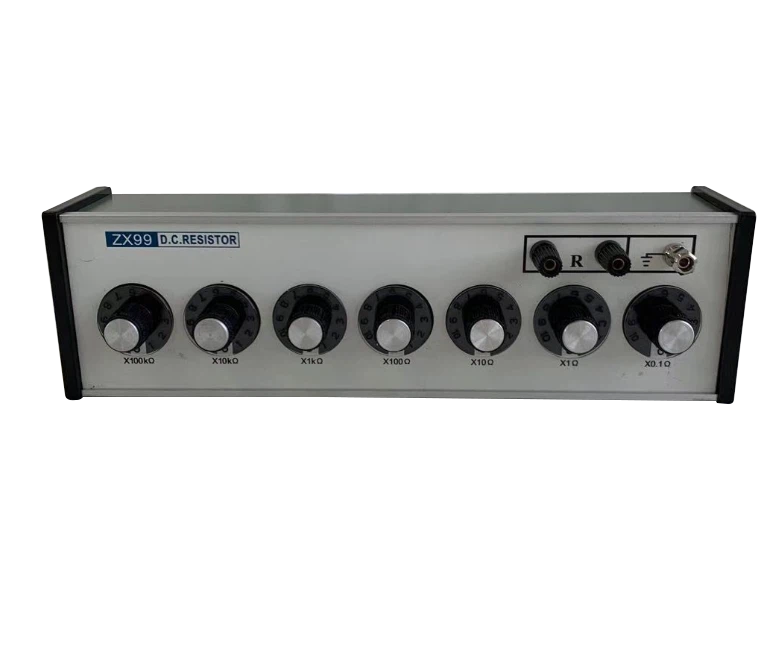
A decade resistance box is a laboratory instrument used to provide a precise, known, and variable resistance in an electrical circuit without needing to change individual resistors.
Think of it as an "all-in-one" kit of highly accurate resistors that you can dial in to any value you need within its range.
Primary Purpose and Key Uses
The main reason to use a decade box is for testing, calibration, and experimentation. Here are its most common applications:
1. Circuit Testing and Prototyping
Simulating Components: When designing a new circuit (e.g., an amplifier or a filter), an engineer might not know the exact resistor value needed for optimal performance. Instead of soldering and desoldering countless fixed resistors, they can use a decade box to quickly "try out" different resistance values and find the perfect one.
Troubleshooting: If a circuit isn't working, a technician can substitute a suspicious resistor with a known-good, precise value from the decade box to see if it fixes the problem.
2. Calibration and Verification of Equipment
This is a critical use in metrology (the science of measurement).
Calibrating Ohmmeters/Multimeters: You can use the highly accurate and known resistance from the decade box to check if a digital multimeter (DMM) is reading values correctly across its entire range.
Testing Bridge Circuits: Instruments like Wheatstone bridges or LCR meters are used to measure unknown electrical values (resistance, capacitance, inductance). A decade resistance box serves as a known, precise reference standard to balance and calibrate these sensitive instruments.
3. Educational Demonstrations
In teaching labs, decade boxes are invaluable.
Teaching Ohm's Law (V = I x R): Students can set a specific resistance (R), apply a fixed voltage (V), and measure the resulting current (I), clearly demonstrating the relationship between the three quantities.
Demonstrating Voltage Dividers, Kirchhoff's Laws, and Thevenin's Theorem: They provide a hands-on way for students to see how changing resistance affects voltage and current in different parts of a circuit, bringing theory to life.
4. Generating Specific Voltage Levels (as a Precision Voltage Divider)
When used in conjunction with a stable voltage source, a decade box can be configured as a precise voltage divider. By setting two specific resistances, you can obtain a very accurate and specific output voltage, which is useful for testing the response of voltage-sensitive devices.
How It Works (The "Decade" Part)
The term "decade" refers to the way the resistance values are organized in multiples of ten.
The box contains several banks (or "decades") of precision resistors.
Each bank is controlled by a rotary switch (or a series of switches) that lets you select a multiple of that bank's base value (e.g., 1 Ω, 10 Ω, 100 Ω, 1 kΩ, 10 kΩ).
Example: A typical box might have six switches labeled:
x 1000 Ω (select 0-9 = 0 to 9000 Ω)
x 100 Ω (select 0-9 = 0 to 900 Ω)
x 10 Ω (select 0-9 = 0 to 90 Ω)
x 1 Ω (select 0-9 = 0 to 9 Ω)
x 0.1 Ω (select 0-9 = 0 to 0.9 Ω)
To set a value of 4,567 Ω, you would dial:
4 on the x1000 Ω switch
5 on the x100 Ω switch
6 on the x10 Ω switch
7 on the x1 Ω switch
Advantages Over a Box of Fixed Resistors
Speed and Convenience: Changing resistance is instantaneous.
Precision: The internal resistors are typically high-precision (e.g., 0.1% or 0.01% tolerance) and low-temperature-coefficient types.
Range: One unit provides a vast range of values.
Reliability: The switches and resistors are designed for long-term stability and repeated use.
Summary
A decade resistance box is a fundamental tool for anyone who needs to introduce a precise and variable resistance into a circuit. Its primary roles are in research, development, calibration, and education, where accuracy, repeatability, and convenience are essential.