

If you're working in power distribution or transformer maintenance, you already know how critical transformer oil is-it's not just a coolant, it insulates internal components and prevents arcing. But recycled transformer oil? It's a double-edged sword: it cuts costs and reduces waste, but if its dielectric strength dips, it can cause catastrophic equipment failure. That's where testing its Breakdown Voltage (BDV) comes in, and if you're a supplier like me, getting the BDV test right isn't just about selling a machine-it's about making sure your customers do it correctly, too.
Wait, let's be real here: a lot of people mess up BDV testing for recycled oil. They skip the sample prep, rush the test, or use the wrong machine, and end up with bad data that leads to unnecessary oil replacement or, worse, leaving a risky transformer in service. As someone who's been in the transformer oil testing equipment game for years, I've talked to dozens of technicians who've had costly mishaps because they took shortcuts. So today, I'm breaking down the actual best way to test recycled transformer oil BDV, straight from the trenches (and with a few of our own machines that we've refined over time).
First, let's start with the basics: what even is BDV? It's the voltage level at which oil stops insulating and sparks (or breaks down). For recycled oil, the minimum acceptable BDV is around 30 kV per ASTM D1816 or IEC 60156 standards-lower than that, and you need to recondition or replace it. But here's the thing: recycled oil has different contaminants than new oil-water, tiny carbon particles, aging byproducts, maybe even leftover debris from the transformer it came from. Those contaminants can shift the BDV wildly if you don't test right, so every step matters.
Step 1: Sample collection-this is the make-or-break part most people ignore. You can't just dip a cup into a used oil drum and call it a sample. For recycled oil, you need a representative sample from the transformer's bottom drain, not the top (where lighter, cleaner oil might settle) or a surface that's been exposed to air, which can introduce moisture. And you can't let it sit for too long-if you take the sample, it should be tested within 48 hours, because water (the biggest enemy of oil insulation) will evaporate or condense depending on temperature. Also, use a glass sample cup, not plastic-plastic can leach chemicals that skew results.
Step 2: Machine selection. This is where a lot of new techs mess up. You don't need a 100 kV tester if your transformer only operates at 35 kV, but you do need a machine that's calibrated, consistent, and meets industry standards. Let's talk about our gear: if you're testing smaller transformers or doing field work, our HZJQ-X1 Portable Transformer Insulation Oil BDV Tester is perfect. It's compact, easy to carry, and handles up to 80 kV-more than enough for most distribution transformers. For labs, we have the HZJQ-1B Insulating Oil Dielectric Strength Breakdown Tester, which has automated sample handling and precise voltage control, so you don't get human error from turning knobs. Wait, if you're doing high-volume testing for multiple recyclers, the 80 kV Transformer Oil Break Down Voltage Tester is a workhorse-fast cycle times, repeatable results. And for smaller on-site tests, the HZJQ-D1 70kV Insulating Oil BDV Testing Machine is lightweight but tough, built for rough job sites.
Step 3: Sample preparation for testing. Now that you've got your sample and machine, don't just pour it in. Recycled oil has bubbles! If you pour too fast, you trap air bubbles between the electrodes, which will make the BDV test read lower than actual. So pour slowly, and let the sample rest for at least 5 minutes after pouring to let bubbles rise. Also, the gap between electrodes-this is non-negotiable. ASTM standards say 2.5 mm (0.098 inches) for BDV testing. If you set it to 2 mm, you'll get a lower breakdown voltage; 3 mm, it'll be higher. Every one of our machines, whether it's the portable HZJQ-X1 or the lab-grade HZJQ-1B, has adjustable electrode gaps, but make sure you calibrate that gap before every test.
Step 4: The test itself. Don't just run one test-run at least 5 consecutive tests on the same sample, and discard the first result. Why? The first breakdown sometimes leaves a conductive residue on the electrodes, which affects the next reading. Wait 2 minutes between each test to let the oil settle, and the machine should ramp up voltage at a steady rate-around 2 kV per second. Our HZ182N 80kV Insulation Oil Withstand Voltage Tester does this automatically, so you don't have to babysit it. If you get a big spread in results (like one test at 22 kV and another at 38 kV), that means your sample has inconsistent contaminants or bubbles weren't removed. Run a couple more tests to make sure.
Wait, here's a common mistake with recycled oil: people think if one test is above 30 kV, it's good. Nope-take the average of the last 4 tests. If the average is under 30 kV, the oil isn't safe. I've seen recyclers ship oil with an average BDV of 28 kV, thinking it was fine, only for a transformer to fail a month later because they skipped averaging.
Step 5: Post-test handling. After you're done, don't just dump the sample. The electrodes might have carbon buildup from a breakdown, so clean them with a lint-free cloth and isopropyl alcohol before the next test. Also, log every result-for recycled oil, you need to track BDV over time to see if reconditioning works. A lot of our customers use our HZJQ-1B's software to store test data, which makes reports way easier for compliance.
Now, let's talk about why this is different from testing new oil. New oil is pretty uniform-contaminants are minimal, so BDV tests are straightforward. Recycled oil has more variables: maybe it was filtered once, but still has micro-carbon, or it absorbed moisture from a leaky transformer. So you can't cut corners on sample prep or test repetition. If you're using a cheap tester that doesn't calibrate, you'll get bad data, which is why our gear is built to meet ASTM D1816 and IEC 60156 standards-we don't cut corners on calibration, because we've seen what happens when others do.
Wait, let's get specific. Last year, a customer who used a no-name BDV tester called us panicking-they tested their recycled oil at 25 kV, so they reconditioned it, tested again, and got 28 kV, so they shipped it. But a month later, the transformer it went into arced. They brought us a sample, and when we tested it with our HZ182N, the average BDV was 31 kV. Turned out the cheap tester's electrode gap was off by 1 mm, so every result was wrong. That's why machine quality matters-way more than most people realize.
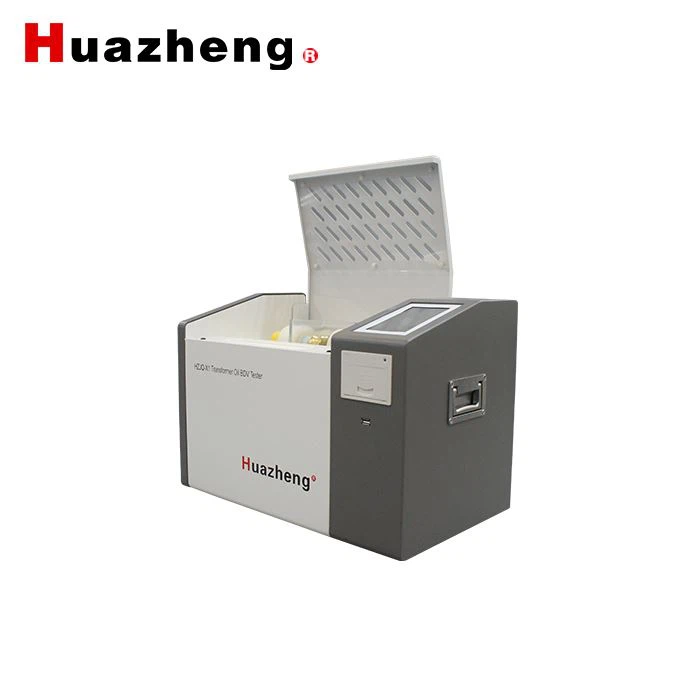

Another thing: if you're doing on-site testing, don't rely on old equipment. Our portable HZJQ-X1 is designed for field use, with a built-in display that shows real-time voltage, and it's battery-powered, so you don't need an outlet at a remote transformer pad. We've had customers use it to test oil right after they drain a transformer, so they don't have to haul samples back to the lab, saving time and money.
Now, let's wrap this up. The best way to test recycled transformer oil BDV isn't just about the machine-it's the whole process: correct sample collection, the right machine for your use case, proper sample prep, multiple tests, and accurate averaging. As a supplier, we don't just sell you a tester; we want you to get reliable results that keep transformers running. If you're looking for equipment that's calibrated, built for these exact tests, and comes with support, check out our line of BDV testers, including the HZJQ-1B, HZ182N, and more.
If you're ready to pick up the right tester for your operation, or have questions about which model fits your needs, reach out to us to discuss your requirements. We're here to help you test right, avoid costly failures, and make sure your recycled oil is safe to use.
References
- ASTM International. (2020). Standard Test Method for Dielectric Breakdown Voltage of Insulating Liquids Using Disk Electrodes (ASTM D1816).
- International Electrotechnical Commission. (2018). Insulating Liquids – Determination of Breakdown Voltage – Part 1: Test Method (IEC 60156-1).
- Transformer Maintenance Institute. (2022). Best Practices for Recycled Transformer Oil Testing.
- Zhang, L., & Wang, H. (2021). Effects of Contaminants on Breakdown Voltage of Recycled Transformer Oil. IEEE Transactions on Dielectrics and Electrical Insulation.