

Alright, folks! As a supplier of high voltage test sets, I've seen firsthand how crucial it is to have effective control methods for these powerful pieces of equipment. In this blog, I'm gonna walk you through the various control methods we use and why they matter.
Let's start with the basics. High voltage test sets are used to test the insulation properties of electrical equipment, cables, transformers, and more. They apply high voltage to the test object to check if it can withstand the specified voltage without any breakdown or leakage. To ensure accurate and safe testing, we need proper control methods.
Manual Control
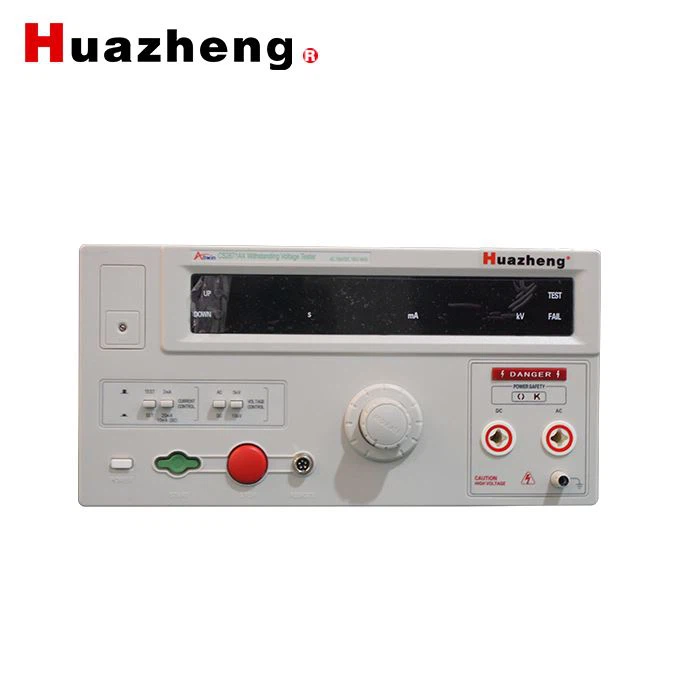
Manual control is the most straightforward way to operate a high voltage test set. It involves adjusting the voltage and current settings using knobs, switches, or buttons on the control panel. This method gives the operator direct hands - on control over the test process. For example, if you're using a small - scale tester like the CS2671AX 5kV 10kV AC DC Hipot Insulation Resistance Tester, manual control can be quite convenient. You can easily increase or decrease the voltage step by step, monitor the readings on the display, and stop the test whenever necessary.
The advantage of manual control is its simplicity. It doesn't require any complex programming or software knowledge. However, it also has some limitations. Manual control can be time - consuming, especially when you need to perform multiple tests with different voltage settings. And there's a higher risk of human error, like setting the wrong voltage or forgetting to stop the test at the right time.
Remote Control
Remote control is a great option when you need to operate the high voltage test set from a distance. This is especially useful in situations where the test area is hazardous or hard to access. With remote control, you can use a handheld device or a computer to send commands to the test set. For instance, if you're testing a large power transformer in a high - voltage substation, you can stand at a safe distance and use a remote control to start, stop, and adjust the test parameters.
There are different types of remote control systems. Some use infrared signals, while others rely on radio frequency or Wi - Fi. The HZZGF 80kV 5mA DC Hipot Testing Device can be equipped with a remote control option for added convenience. Remote control not only improves safety but also allows for more efficient testing, as you can quickly make adjustments without having to physically go to the test set.
Programmable Control
Programmable control takes the automation of high voltage testing to the next level. With this method, you can pre - set a series of test parameters, such as voltage levels, test durations, and current limits, using a built - in microcontroller or external software. Once the program is loaded, the test set will automatically perform the test according to the specified sequence.
This is extremely useful for repetitive testing tasks. For example, if you're testing a batch of cables, you can create a program that applies different voltage levels for specific durations to each cable. The HZDP - 40KV 40kV VLF Cable High Voltage Test System supports programmable control, which can significantly reduce testing time and improve accuracy. Programmable control also allows for detailed test reports, as the test set can record all the relevant data during the test.
Computer - Based Control
Computer - based control combines the power of programmable control with the flexibility of a computer. You can connect the high voltage test set to a computer via a USB, Ethernet, or serial port. Then, you can use specialized software to control the test set, monitor the test process in real - time, and analyze the test results.
The software provides a user - friendly interface where you can easily set up test programs, view live data, and generate comprehensive reports. It also allows for data storage and retrieval, which is useful for quality control and compliance purposes. Computer - based control is especially beneficial for large - scale testing facilities where multiple test sets need to be managed simultaneously.
Safety Interlocks
In addition to these control methods, safety interlocks are an essential part of high voltage test set control. Safety interlocks are devices or circuits that prevent the test set from operating unless certain safety conditions are met. For example, they can ensure that the test object is properly connected, the ground connection is secure, and the test area is clear of personnel.
Most modern high voltage test sets are equipped with multiple safety interlocks. If any of the safety conditions are not met, the test set will automatically shut down or prevent the voltage from being applied. This helps to protect both the operator and the test equipment from potential hazards.

Monitoring and Alarms
Monitoring and alarm systems are also important for the control of high voltage test sets. They continuously monitor the key parameters of the test, such as voltage, current, and temperature. If any of these parameters exceed the pre - set limits, an alarm will be triggered.
The alarm can be visual, like a flashing light on the control panel, or audible, such as a beeping sound. This alerts the operator to take immediate action, such as stopping the test or adjusting the settings. Monitoring and alarm systems add an extra layer of safety and help to ensure the reliability of the test results.
Conclusion
So, there you have it! These are the main control methods of high voltage test sets. Each method has its own advantages and is suitable for different testing scenarios. Whether you need simple manual control for a small - scale test or fully automated programmable control for a large - scale production line, we have the right solution for you.
If you're in the market for a high voltage test set or want to learn more about our products and control methods, don't hesitate to reach out. We're here to help you choose the best equipment and ensure accurate, safe, and efficient testing. Let's start a conversation and find the perfect fit for your testing needs.
References
- Electrical Testing and Commissioning Handbook, by John Towne
- High Voltage Engineering: Theory and Practice, by M. S. Naidu and V. Kamaraju
- Standards and Guidelines for High Voltage Testing, International Electrotechnical Commission (IEC)